The Computer Made Me Do It
At O Street play and experimentation are a key part of our creative process (read about our Last.fm slip-mat or our Roadliners project)
As designers we’re instinctively taught to control outcomes. For me, experimentation is about breaking some of those rules, not overthinking things, and allowing space for a bit of fun.
Creative coding has become a space where that kind of play is possible. Instead of designing a fixed outcome, you design a system: writing rules, introducing variables, and leaving room for randomness.
Coding follows the logic you enter, but within that structure there is space for chance, so the results aren’t entirely your own, they’re shared with the computer. It becomes a kind of collaboration and there’s always an element of surprise in seeing what comes out of the process.
In one of our recent vision days I hosted a mini workshop to bring this concept to life
The Workshop:
The structure was simple, everyone was given 9 Post-its and a blank piece of paper.
Phase 1: Design freely.
Compose something balanced, intentional and considered as we naturally would.This was traditional authorship ; intuitive, visual and controlled. And then we swapped compositions.
Phase 2: The system intervenes.
Each person rolled a dice three times and each roll triggered a mutation:
1. Remove two Post-its
2. Rotate three Post-its diagonally
3. Move one Post-it to a completely different area
4. Rotate the composition 90°
5. Add one Post-it anywhere
6. Create one large empty gap
There was no redesigning, no correcting and no reclaiming control purely just execution, without thinking.
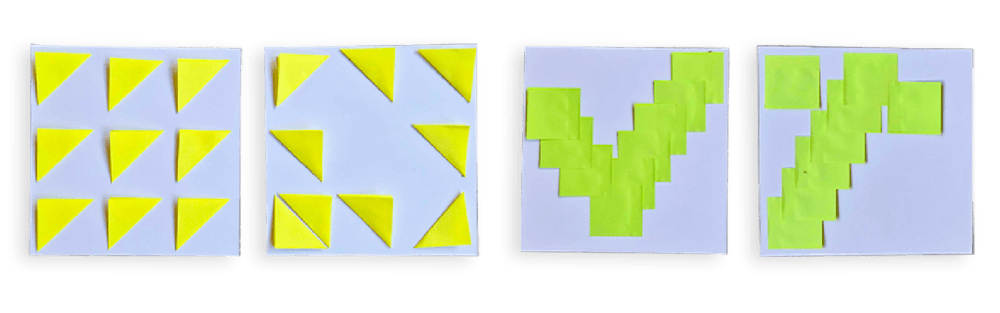
When we looked at the compositions together it was interesting to see what had happened. The experience of loosening up and giving away control resulted in unexpected and playful results. Authorship became shared as randomness pushed the work somewhere new.
In computational work randomness is often described as noise, but it can also act as a collaborator, a way of revealing configurations we might never have chosen deliberately. The exercise mirrored what happens in generative work: you define a system, introduce variables and let it run.
For me that’s where play becomes valuable. When you stop trying to control every outcome and allow space for experimentation, new ideas begin to emerge often from places you wouldn’t have arrived at by design alone.
Next up:
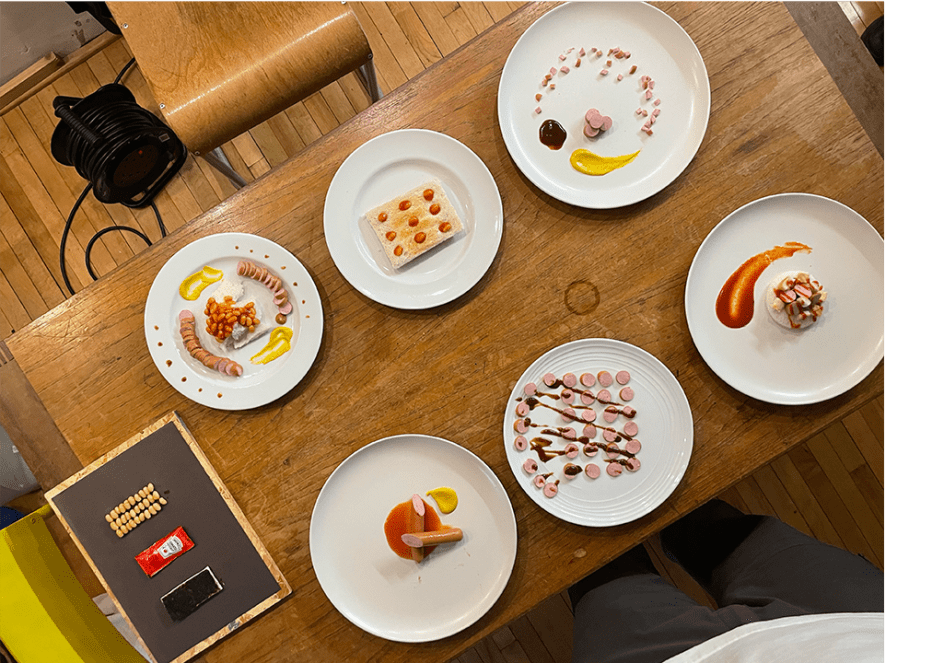
Andrews workshop where we played with sausages & beans. I am saying no more, but here is some of the photographic evidence!